
Beyond Weight Reduction: Side Benefits of GLP-1s
Weight reduction tends to dominate headlines but besides the intended benefits, there are additional metabolic enhancements these compounds offer that could be even more impactful for long-term health outcomes. Both tirzepatide and retatrutide influence blood sugar regulation, liver health, heart-related markers, and inflammation pathways, although their strengths in each aspect vary.
Blood Sugar Management and Type 2 Diabetes
Tirzepatide was first approved by the FDA specifically to treat type 2 diabetes, marketed as Mounjaro. Its ability to control blood glucose is outstanding. In the SURPASS trials, tirzepatide lowered HbA1c by 2.0-2.4%, depending on the dose, helping most participants achieve levels below 7.0%.
Retatrutide shows similar improvements in blood sugar levels. In Phase 2 studies involving individuals with type 2 diabetes, HbA1c decreased by up to 2.2%, with 82% reaching HbA1c at or below 6.5%. The triple receptor mechanism seems to match or even slightly surpass tirzepatide for blood sugar control. This is likely because, although glucagon alone can raise blood sugar, working together with GLP-1 and GIP activation creates a net positive effect on glucose regulation.
For those focused on metabolic health improvements rather than just weight loss, both drugs yield remarkable results. Choosing between them for glucose control alone would probably favor tirzepatide since it is already available and well-proven, whereas retatrutide remains experimental.
Liver Fat Reduction
This is an area where retatrutide clearly outperforms.
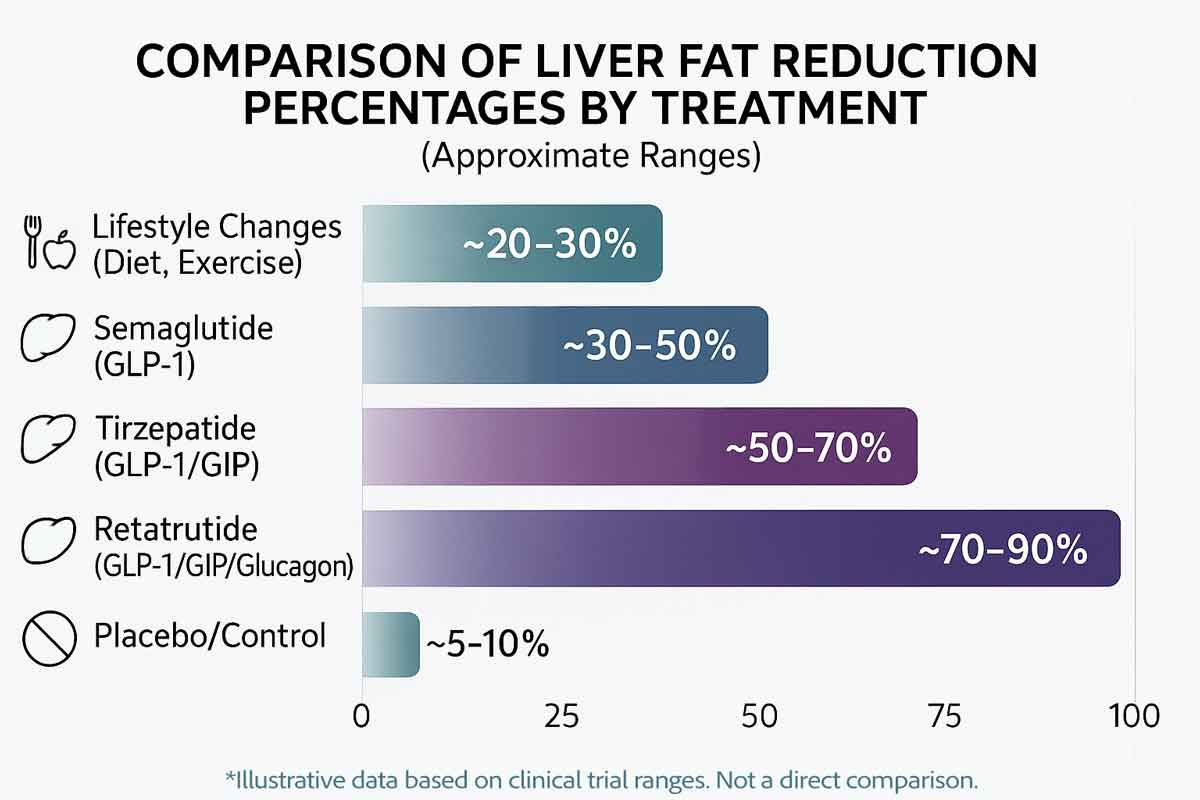
In a Phase 2a trial specifically examining liver outcomes, retatrutide achieved an average reduction of 82% in liver fat. That’s extraordinary. To compare, lifestyle interventions usually lead to a 20-30% reduction, and semaglutide typically results in about 40-50% reduction in similar studies.
Tirzepatide also decreases liver fat, with meaningful improvements shown, but it doesn’t reach the levels retatrutide can achieve. The key difference lies in glucagon receptor activation, which directly promotes liver fat oxidation—encouraging the liver to burn stored fat. This has important implications for the estimated 100 million Americans with fatty liver disease, many of whom currently lack effective drug treatments.
Currently, a Phase 3 trial is underway to evaluate retatrutide specifically for metabolic-associated steatotic liver disease. If the promising Phase 2a results are confirmed, retatrutide could become the first truly effective medication for this condition.
Cardiovascular and Kidney Health Outcomes
Tirzepatide has cardiovascular safety data from the SURPASS-CVOT study, which demonstrated positive effects on major adverse cardiovascular events in people with type 2 diabetes. Compared to other weight loss methods, tirzepatide shows significant reductions in blood pressure, triglycerides, and markers of inflammation related to heart disease.
Retatrutide does not yet have specific cardiovascular or kidney outcome data, though Phase 3 trials evaluating these endpoints are recruiting participants and are expected to finish in 2026. Early results from obesity studies indicate favorable trends in cardiovascular risk factors, but concrete outcome data is still upcoming.
For researchers emphasizing cardiovascular safety, tirzepatide currently provides the most reassurance since its data is available. Retatrutide may eventually prove equal or better, but proof remains to be seen.
Joint Pain and Osteoarthritis
The TRIUMPH-4 trial uncovered an unexpected but welcome benefit regarding joint health. Participants with knee osteoarthritis experienced striking pain relief along with weight loss.
Retatrutide lowered WOMAC pain scores by up to 4.5 points (75.8% improvement) at the 9 mg dose and by 4.4 points (74.3% improvement) at the 12 mg dose. Notably, 14.1% of those on 9 mg and 12.0% on 12 mg were completely free of knee pain by the end of the study. In comparison, only 4.2% of placebo recipients experienced total pain relief.
Most of this pain reduction likely results from the significant weight loss reducing mechanical stress on joints. However, some experts speculate that glucagon receptor activation might also help reduce joint inflammation through pathways independent of weight loss. Further research is needed to confirm this.
Tirzepatide has not been specifically studied for osteoarthritis outcomes. Still, weight loss from any treatment generally improves joint discomfort. The remarkable improvements seen with retatrutide, driven by its greater weight reduction, could offer a substantial advantage for those dealing with obesity-related joint issues.

Leave a Reply
Want to join the discussion?Feel free to contribute!